Flexible Studios: Rethinking Org Design for the AI Era (Part One)
Over the last year, I've spent less time thinking about AI tools and more about organizational design. Here's the conclusion I keep arriving at: people need stable homes, but the work needs to move.
Like most organizations, we've been experimenting with AI across almost every part of our work. Research, design, engineering, documentation, planning, prototyping. There isn't really a part of the product development process that hasn't been affected in some way. At first, I assumed the challenge would be helping people learn new tools and figuring out which models fit into our workflows. That turned out to be relatively straightforward.
The more interesting challenge has been organizational.
As I watched my own team work, I realized our operating model was built around assumptions that are starting to disappear. AI wasn't simply making individuals more productive. It was changing how work naturally flowed through the organization, and that made me question whether the organization itself should evolve alongside it.
For decades, large organizations have been structured around functions. Design, engineering, product, research, marketing, operations. Each function owns a portion of the delivery process, and work moves from one group to the next until something eventually reaches customers.
There were good reasons for this.
Every stage required specialized expertise, production costs were high, and functional depth was how organizations scaled craft.
The downside was that work became fragmented. Every transition from one team to another required context to be translated. Research became requirements. Requirements became designs. Designs became tickets. Intent slowly became interpretation. As organizations grew, these handoffs multiplied, making it increasingly difficult to move quickly without creating layers of coordination.
That model has served us well for decades. I'm just not convinced it's the model AI is optimizing for.
One of the biggest shifts I've noticed isn't that AI replaces expertise. It's that it compresses the distance between disciplines.
Today I regularly see designers building production-quality prototypes, engineers exploring interaction concepts, product managers synthesizing research, and AI agents generating documentation, code, test plans, analyses, and prototypes in minutes. The boundaries between functions haven't disappeared, but they're becoming much less rigid than they once were.
Last quarter, we increased our velocity by 50% while also increasing our quality and impact on business outcomes. And we expect the velocity to increase each quarter exponentially as we codify our skills and mature our new AI tooling and processes. What would normally take dozens of people to deliver on our priorities now takes just a 1-3 person team that includes AI as a collaborator.
As production becomes easier, the value of simply producing artifacts starts to decline. What becomes more valuable is understanding the problem, asking better questions, making sound decisions, and shaping an outcome. Those activities don't belong neatly to any one function. They require different forms of expertise working together at the same time.
So I changed how I staff my team. Instead of asking which function owns a piece of work, I now ask a different question:
What's the right combination of human expertise, judgment, and AI capabilities required to solve this problem?
It's a subtle shift, but I think it's an important one. The unit of organization stops being the function and starts becoming the problem.
There's a second shift underneath this one: we've been coupling two different things together for too long.
People need stability. They need leaders who coach them, help them grow, develop their craft, and think about their careers over years, not quarters.
The work doesn't.
Projects change. Priorities shift. New opportunities emerge. AI makes it possible for much smaller teams to solve much bigger problems than they could before.
What if the reporting structure stayed stable while the work became fluid? That's the model we've been experimenting with.
Internally, I've started calling it Stable Homes and Flexible Studios: people belong to a stable home, led by someone responsible for their growth and craft, and move between flexible studios assembled around problems.
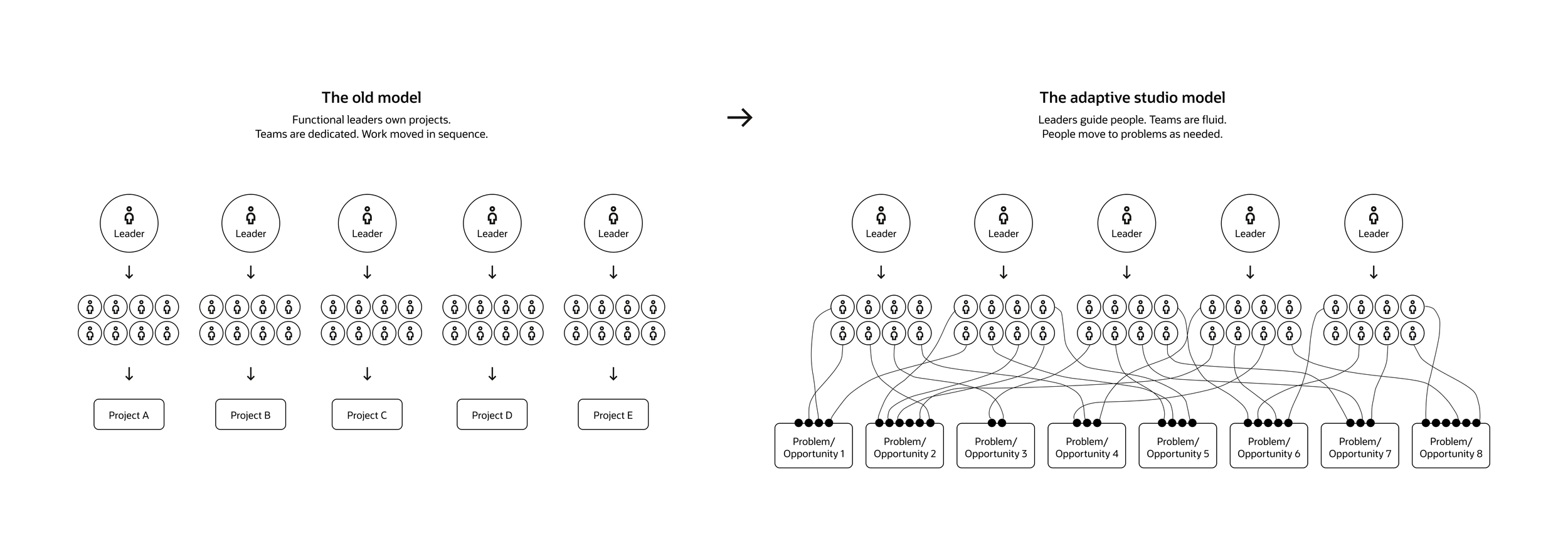
The diagram captures the shift I've been thinking about. On the left is the model many of us inherited. Functional leaders own projects, teams stay attached to those projects, and work flows from one discipline to the next.
On the right, leadership remains stable, but work does not. People continue reporting to leaders who are responsible for coaching, growth, and craft development, while moving fluidly between problems as organizational priorities evolve. The organization becomes less about routing work through departments and more about assembling the right mix of human expertise and AI capabilities around the outcomes that matter most.
We're still experimenting, and we haven't figured it all out. But every experiment so far points the same direction: the organizations that adapt fastest won't be the ones with the best AI tools. They'll be the ones that reorganized around problems instead of functions.
In my next post, I'll go deeper into how the model works in practice.
How we form studios around problems, how AI agents staff into them alongside people, and what we've learned so far, including what hasn't worked.
I'd love to hear how others are thinking about this.
Are you still organized around functions, or have you started reorganizing around problems?
Has AI changed the way you're thinking about your organization?